Why Contractors Use Trenchers for Underground Utility Work
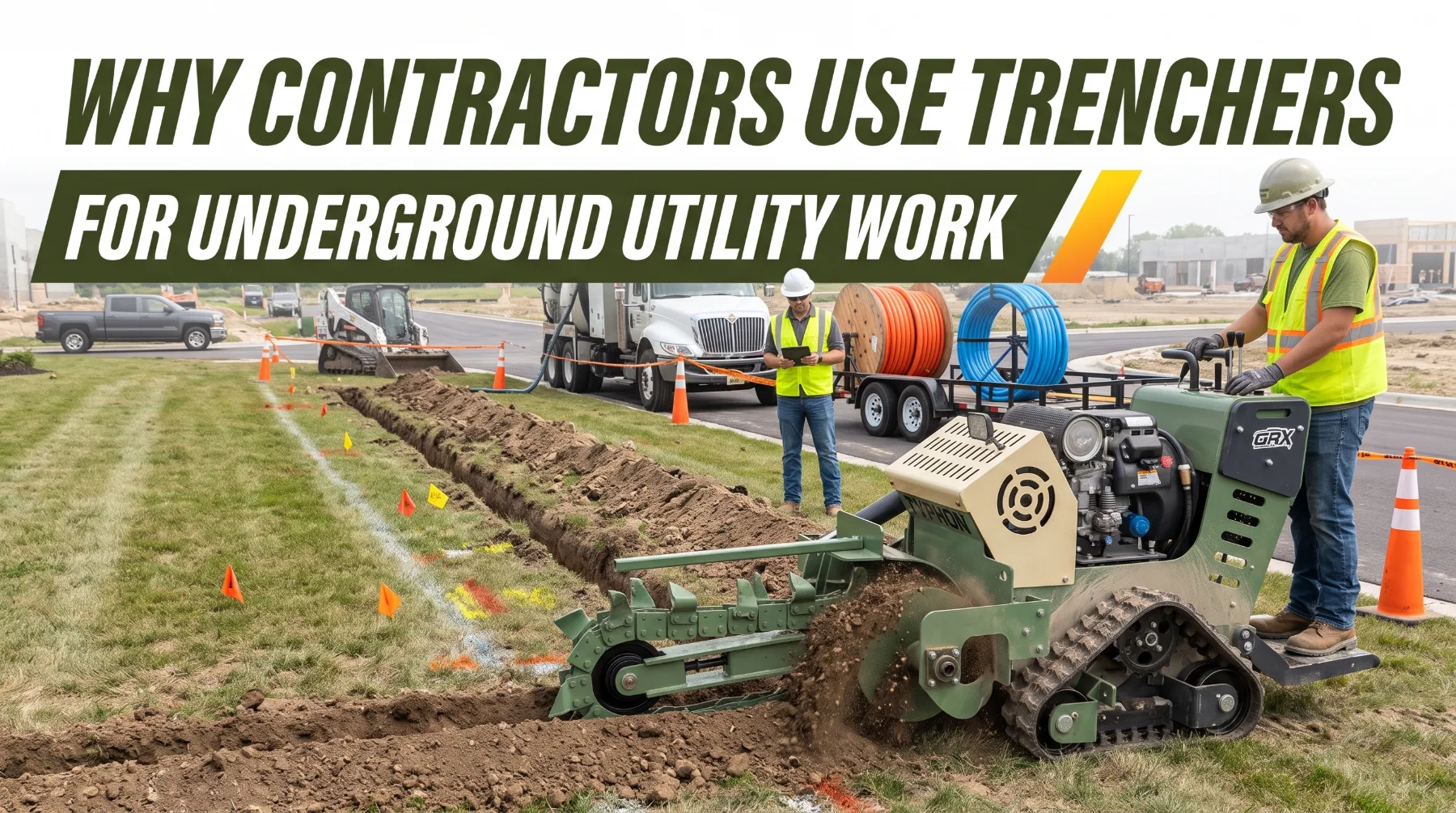
Underground utility work depends on precise excavation. An irrigation main needs a trench at the right depth and grade. A fiber conduit run needs a narrow, clean cut that keeps restoration to a minimum. An electrical feeder needs a trench deep enough to meet cover requirements and wide enough for conduit, bedding, and separation from other services. When the trench is wrong, everything that follows takes longer. Crews hand-dig to correct depth, haul in extra backfill, and repair more lawn, pavement, or landscaping than the job required.
Trenchers are built for this kind of work. Instead of scooping material one bucket at a time, a trencher cuts continuously with a chain, wheel, or saw, throws spoil neatly to one side, and moves steadily along the line. On a long run, that continuous action produces trench dimensions that a general-purpose bucket rarely matches. Contractors installing irrigation, drainage, electrical conduit, communication cable, and small water and gas service lines rely on trenchers to keep footage high and trench quality consistent from start to finish.
A trencher is not the right answer for every excavation, though. It cuts a narrow, linear trench, so it isn't suited to wide pits, structure excavations, or work that requires frequent changes in direction. Its performance depends on soil type, rock content, moisture, and the cutting system fitted. Safety is also central to trenching. Contact with buried utilities, trench collapse, and entanglement with the moving cutting chain are among the most serious hazards on any utility jobsite.
Create Consistent Trench Dimensions
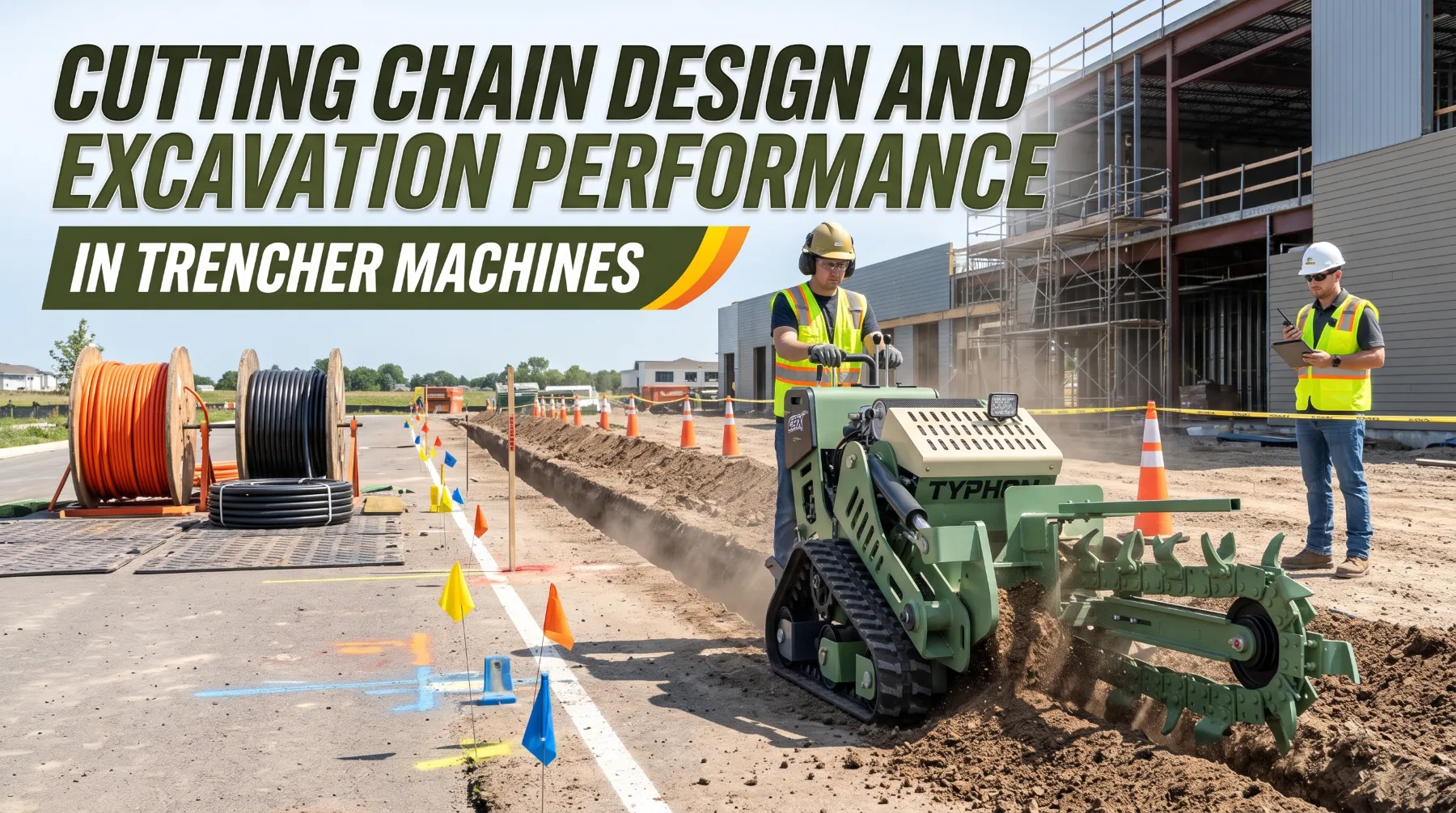
A trencher digs by moving a cutting tool through the ground in a fixed path. On a chain trencher, a loop of chain fitted with teeth travels around a boom, tearing material loose and carrying it up out of the cut. A spoil auger then moves it to the side of the trench. Many machines also use a crumber, a curved shoe that follows the chain and scrapes loose material from the trench floor. Wheel trenchers, often called rockwheels, use a toothed wheel to cut harder ground, while microtrenchers use a narrow saw blade to cut shallow slots in pavement for fiber installation.
Because the cutting tool has a fixed width and the boom is held at a set depth, the trench comes out with a consistent cross-section along its length. Width is controlled by the chain, tooth pattern, or wheel size, and depth is controlled by the boom position. A skilled operator can hold that depth steadily over hundreds of feet, producing a uniform trench floor with fairly clean walls. A bucket, by contrast, is usually wider than the utility needs and digs in overlapping passes, which leaves a wider trench, an uneven floor, and more spoil to manage.
Consistency matters for several reasons. A uniform trench width reduces the volume of material removed and the volume of bedding and backfill needed to replace it. A steady depth helps meet minimum cover requirements without overdigging, and an even floor lets pipe and conduit sit properly on bedding. Narrow, clean trenches also limit surface damage on finished lawns, turf, and landscaped areas, which reduces restoration cost and keeps property owners satisfied.
Holding dimensions depends on setup and maintenance as well as design. Worn teeth narrow the trench, a loose chain lets the cut wander, and a worn crumber leaves loose material on the floor. Check trench width and depth at regular intervals along the run with a tape measure or grade rod, working from outside the trench. Never enter a trench to take measurements unless it has been evaluated by a competent person and is protected as required. Follow the manufacturer's specifications for maximum digging depth, chain configuration, and boom setup, and adjust or service the machine as soon as measurements begin to drift.
Key takeaway: Trenchers produce a consistent trench width and depth because the cutting tool follows a fixed path, which reduces spoil, bedding, backfill, and restoration, provided the cutting system is maintained and dimensions are checked from outside the trench.
Improve Efficiency on Long Utility Runs
The real strength of a trencher shows on long, linear runs. Irrigation mainlines across sports fields, electrical conduit to site lighting, drainage lines along building perimeters, and communication cable down residential easements all involve hundreds or thousands of feet of trench. A trencher cuts continuously, so it doesn't stop to fill, swing, and dump the way an excavator does. The operator sets depth, engages the cutting system, and advances at a steady pace while spoil discharges to one side.
That continuous action reduces repeated digging and repositioning. An excavator on the same job digs a short section, moves back, digs again, and repeats, with each cycle adding time and opportunities for depth variation. A trencher simply keeps moving. On suitable ground, that often translates into more footage per day with a smaller crew. It also means less fuel spent swinging and repositioning, and less ground disturbance from repeated tracking over the same area.
Actual productivity depends on several factors working together. Soil type and rock content set how fast the machine can cut. Trench depth and width determine how much material moves with each foot of travel. Machine horsepower and cutting system condition decide whether the trencher maintains speed under load, and operator experience determines how well chain speed and travel speed are balanced. A trencher running dull teeth in rocky ground may be slower than a well-run excavator. Plan productivity from realistic conditions, track footage per hour on each job, and use that data to estimate future work.
Efficiency should never come at the expense of safety. Pushing travel speed past what the chain can cut stalls the machine, shock-loads the drivetrain, and can cause the boom to climb or wander. Keep everyone clear of the boom, chain, and spoil auger, and mark an exclusion zone around the machine as it advances.
Key takeaway: Trenchers deliver their greatest value on long, linear runs because they cut continuously and place spoil neatly beside the trench, but real productivity depends on soil, trench size, machine condition, and operator skill.
Work Safely Around Existing Utilities
Underground utilities create some of the most serious hazards in trenching. A cutting chain can sever an electrical cable, rupture a gas line, or break a water main in an instant. Striking an energized line can electrocute the operator or anyone touching the machine. A damaged gas line can cause a fire or explosion. Even a cut fiber cable can disrupt service for thousands of customers and lead to costly repair claims. Contractors use trenchers because they're fast, and that speed means there's very little time to react once a chain meets a buried service.
Utility locating must come first. Contact the local one-call service before any digging, which is 811 in the United States, and allow the required waiting period for utility owners to mark their lines. Confirm that every expected utility has responded and that the marks cover the full route, including any changes made since the original request. Keep the locate ticket on site, and request a new location if marks fade, the ticket expires, or the route changes.
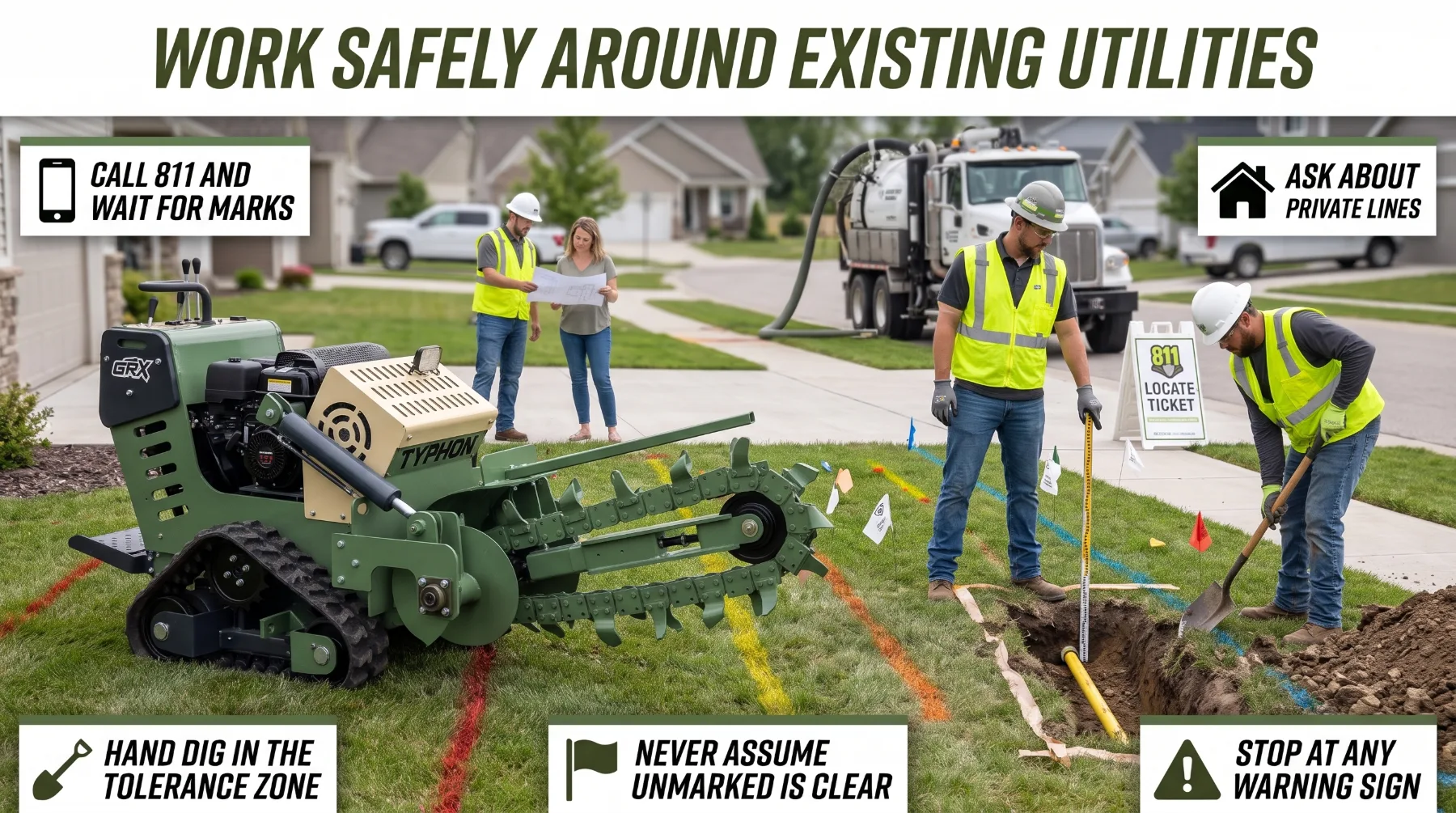
One-call services generally mark only lines owned by member utilities. Private lines are often left unmarked, including irrigation systems, outdoor lighting, gate operators, septic systems, propane lines, and feeds to detached garages, pools, and outbuildings. Ask the property owner or facility manager about private utilities, review any available as-built drawings, and consider hiring a private locating service for complex sites.
Respect the tolerance zone around every mark. Most states define a tolerance zone extending a set distance, often 18 to 24 inches, on either side of the marked line. Within that zone, mechanized excavation is typically prohibited until the utility has been exposed by hand digging or vacuum excavation. Where the trench crosses a marked utility, expose it carefully, confirm its exact location and depth, and plan the crossing so the cutting chain never contacts it. Lift the boom clear and hand-dig through the crossing where required.
Never assume that an unmarked area is free of buried infrastructure. Marks can be inaccurate, records can be incomplete, and abandoned lines may still be live. Watch for warning signs as you cut, such as warning tape, colored conduit, sand or gravel bedding, concrete encasement, or a change in soil color. If any appear, stop immediately and investigate by hand.
If a utility is struck, stop work at once. For a gas line, shut down the engine if it is safe to do so, move everyone away and upwind, and call 911 and the utility owner. Don't try to stop the leak, and avoid any source of ignition. For an electrical line, the operator should stay on the machine unless fire or another danger forces an exit. If leaving is unavoidable, jump clear with both feet together without touching the machine and the ground at the same time, then shuffle away with small steps. Keep everyone else back, and report every strike to the utility owner, even if the damage appears minor.
Look up as well as down. Overhead power lines near the route or the transport path must be treated as energized, with the required clearance distances maintained. Keep an exclusion zone around the boom, chain, and spoil auger during operation, and make sure ground workers make eye contact with the operator before approaching.
Key takeaway: Call 811 and wait for marks, ask about private lines, expose utilities by hand or vacuum within the tolerance zone, stop at any warning sign, and follow emergency procedures if a utility is struck.
Select the Correct Trench Width and Depth
Every utility installation has its own requirements for trench width, depth, bedding, cover, and separation from other services. These come from project drawings, utility owner standards, the manufacturer's installation guidance for the pipe or conduit, and applicable codes. Before selecting a trencher, gather those requirements and confirm that the machine can deliver them.
Width needs to accommodate the utility plus any required bedding and working room. A single small irrigation lateral may need only a few inches of width, while a larger drainage pipe with granular bedding needs considerably more. Where multiple utilities share a trench, the required separation between them sets the minimum width. A trench that is too narrow makes it difficult to place bedding properly and can damage pipe or conduit during installation. One that is too wide wastes time and material and may affect how the pipe performs under load.
Depth must provide the specified cover above the utility once the trench is backfilled and the surface is restored. Electrical conduit, water lines, gas services, and communication cable each have their own minimum cover, which may vary with location and whether the line crosses a driveway, road, or landscaped area. Many water lines must also sit below the local frost depth. Add bedding thickness beneath the utility when calculating cut depth, and account for any planned changes in final grade.
Maximum digging depth on a specification sheet isn't always the practical working depth for every job. That figure is usually measured under ideal conditions. In rock, wet clay, or unstable soil, the machine may not cut cleanly to its full rated depth, and trench walls may not stand at that depth. Deeper trenches also increase the load on the drivetrain and the time spent per foot. Compare the trencher's published digging specifications against the project drawings with a sensible margin, rather than choosing a machine that reaches the required depth only at its absolute limit.
Key takeaway: Base trench width and depth on project drawings and utility requirements, including bedding, cover, separation, and frost depth, choose a trencher with a sensible depth margin, and plan protective systems and safe access for any trench workers must enter.
Consider Transport, Access, and Maintenance
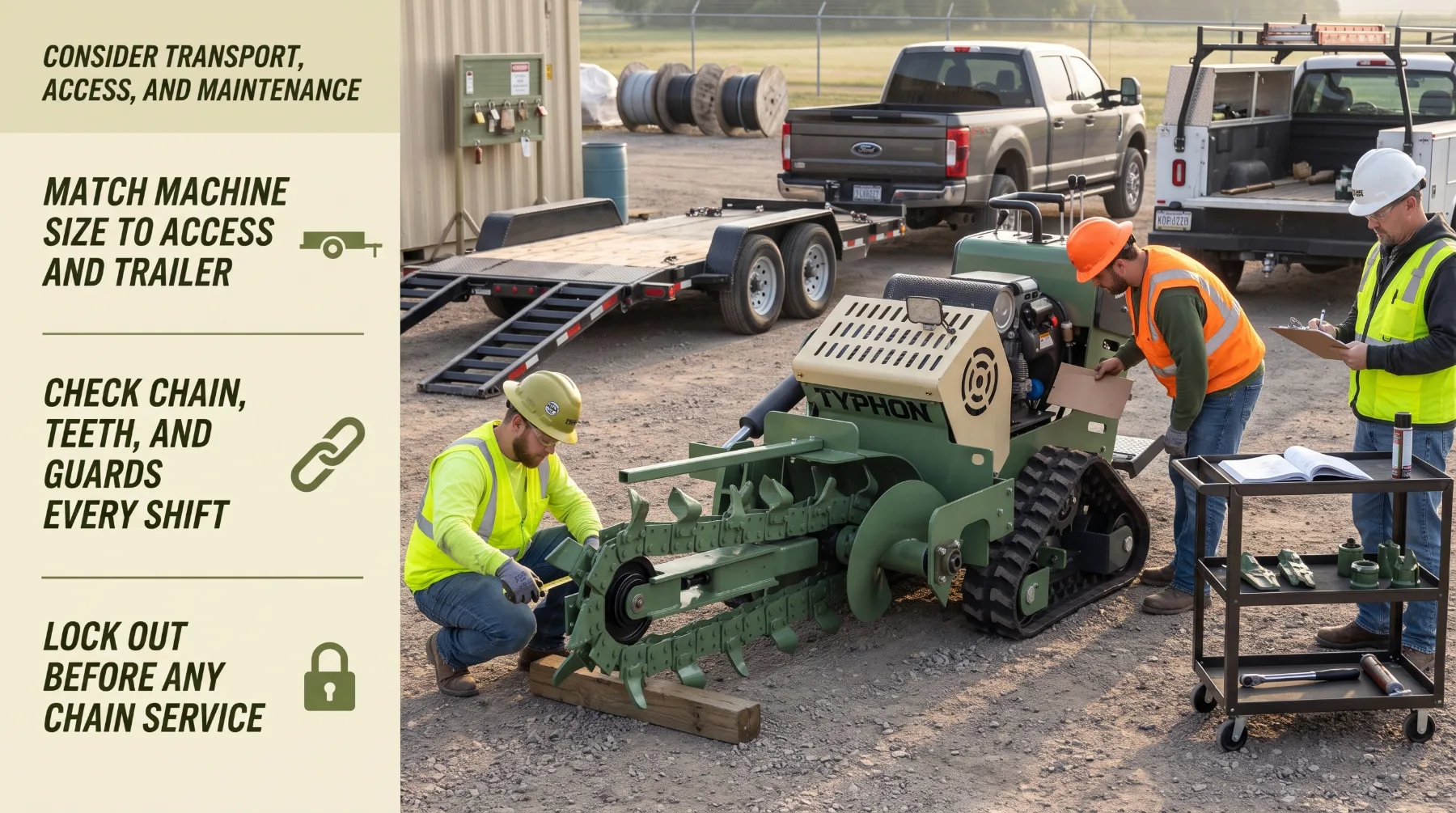
A trencher has to reach the work before it can dig. Walk-behind trenchers suit residential yards, gates, and landscaped areas where larger machines can't fit. Ride-on trenchers deliver more power and depth for longer runs and harder ground. Trencher attachments for compact track loaders and skid steers let contractors use equipment they already own. Larger tracked and wheeled trenchers handle deep, heavy-duty utility work. Choose the size that fits your typical access conditions and trench requirements rather than the largest machine available.
Check overall dimensions and operating weight against your access routes and transport equipment. Measure gates, side yards, and pathways, and remember that the boom and spoil auger may extend beyond the chassis. Confirm that the trailer and towing vehicle are rated for the machine's weight, and use the manufacturer's designated tie-down points with suitable restraints. Raise the boom to its transport position and secure it as the manual instructs. Load and unload only on firm, level ground with ramps rated for the machine, and keep people clear of the loading area. On finished lawns and landscaped sites, ground protection mats help limit damage from tracks or tires.
Maintenance keeps a trencher productive and safe. The cutting system wears faster than almost any other part of the machine, so inspect it before every shift. Check chain tension using the manufacturer's sag measurement and procedure, since a loose chain can derail and an overly tight chain overloads pins, bushings, and sprockets. Inspect teeth for rounded edges, chipped carbide, and wear approaching the mounts, and replace them before they damage the chain. Look at the drive sprocket, idler, boom wear strips, crumber, and spoil auger for wear and damage. Grease bearings and pivots at the manual's intervals, and more often in wet, sandy, or abrasive conditions. Lubricate the chain only if the manufacturer specifies it, since oil on an exposed chain can attract abrasive grit.
Most serious trencher injuries involve contact with a moving chain, often during cleaning, tooth changes, or clearing jams. Before any service or inspection near the cutting system, disengage the chain drive and wait for the chain and auger to stop. Lower the boom to the ground or support it with approved blocking, engage the parking brake, and shut down the engine. Remove the key, apply your lock and tag, relieve hydraulic pressure as the manufacturer instructs, and verify isolation. Never jog the chain under power with hands nearby, and use tools rather than hands to remove packed spoil.
Service support completes the picture. Confirm parts availability for chains, teeth, sprockets, and wear parts, review service intervals, and evaluate the dealer's response times and technician support. Keeping common wear parts on hand can turn a multi-day delay into a repair finished before lunch.
Key takeaway: Choose a trencher size that fits your access and transport capacity, inspect the cutting system and hydraulics every shift, check leaks with cardboard, keep guards in place, and lock out completely before any service near the chain.
Conclusion
Contractors use trenchers for underground utility work because they create consistent, narrow trenches and handle long, repetitive runs far more efficiently than general-purpose buckets. That consistency reduces spoil, bedding, backfill, and restoration, while continuous cutting keeps footage moving with smaller crews. Getting those results depends on matching the cutting system to the soil, confirming that the machine can deliver the required trench width and maximum cutting depth with sufficient margin, and planning protective systems where trenches are deep or ground is unstable. The trencher's cutting depth should match the required utility installation depth to avoid repeated passes and unnecessary excavation. Strict utility locating, careful work within tolerance zones, and disciplined maintenance and lockout protect both the crew and the infrastructure already in the ground.
Frequently Asked Questions
What utility jobs can a trencher handle?
Trenchers excavate narrow, linear trenches for irrigation lines, drainage pipes, electrical conduit, communication and fiber cable, low-voltage lighting, and small water and gas service lines. They are most efficient on long runs where trench dimensions stay consistent. They're less suited to wide excavations, structure pits, or routes with frequent sharp changes in direction. Match the machine's width, depth, and cutting system to the specific installation requirements.
Is maximum digging depth the same as working depth?
No. Maximum digging depth is measured under specified conditions and represents the machine's limit. Practical working depth depends on soil type, rock content, moisture, wall stability, and the cutting system fitted. In hard or unstable ground, the machine may not cut cleanly to full depth. Choose a trencher that reaches your required depth with a sensible margin, and plan protective systems for trenches 5 feet deep or more.
Can a trencher cut through rocky ground?
Some configurations can. Carbide-tipped rock teeth in a dense pattern, paired with slower chain speed and reduced travel speed, handle many types of hard ground. Wheel trenchers and heavy-duty ride-on machines are designed for tougher rock. Suitability depends on rock type, hardness, and the machine's power and cutting system, so follow the manufacturer's recommendations and use dust controls where cutting creates silica dust.
What should contractors do before trenching?
Contact 811 or the local one-call service and wait for utilities to be marked. Ask the property owner about private lines, and expose marked utilities by hand or vacuum excavation within the tolerance zone. Review project drawings for trench width, depth, cover, and separation. Identify soil conditions, inspect the site and access route, select a suitable trencher and cutting setup, and complete a pre-shift inspection of the machine.