Electric Forklift vs Diesel Forklift for Indoor and Outdoor Material Handling
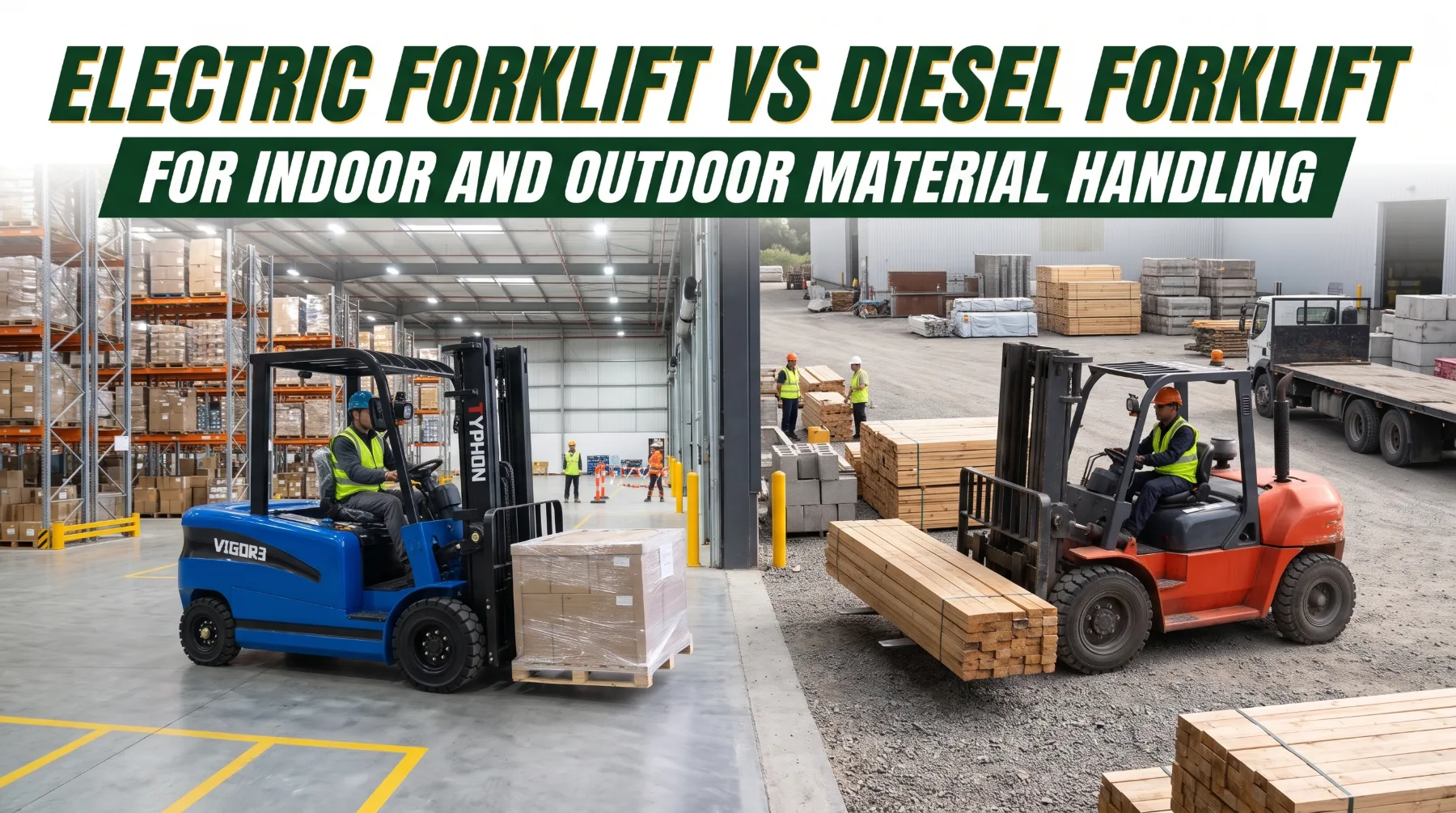
A regional distribution center runs two shifts inside a sealed building with polished concrete floors, narrow aisles, and food-grade products on the racks. A few miles away, a building supply yard unloads bundled lumber, block, and steel from flatbeds onto gravel lots in rain, heat, and wind. Both operations depend on forklifts, and both need trucks that lift reliably all day. The right power source for each one is completely different.
Electric and diesel forklifts are designed for different material handling environments. Electric models are widely used indoors, where exhaust at the point of use is unacceptable and quiet operation matters. Diesel forklifts are commonly selected for demanding outdoor work, where rough ground, heavy loads, and long hours favor a combustion engine and fast refueling. Many businesses also run mixed operations, where trucks move between a warehouse and an outdoor yard. Those sites need even more careful planning.
Choosing between the two is not a matter of which power type is "better." The right forklift depends on where it works, what it lifts, how many hours it runs, and what your facility can support in charging, fueling, ventilation, and service. Matching those factors protects your workers, your products, and your budget.
Power Source and Operating Environment
The power source shapes nearly every other part of forklift ownership. It determines where the truck can operate safely, how it is refueled or recharged, and what infrastructure your facility needs to support it.
Electric forklifts use a large rechargeable battery to power traction motors for travel and a hydraulic pump motor for lifting, tilting, and attachments. The battery also serves as part of the truck's counterweight on many designs. Two battery types are common. Lead-acid batteries have been the industry standard for decades and typically need a full charge cycle, a cooling period, and routine watering, with multi-shift operations often swapping discharged batteries for charged spares. Lithium-ion batteries cost more upfront but generally support opportunity charging during breaks, require no watering, and maintain steadier power as they discharge. Electric trucks come in several configurations, including counterbalance models with cushion tires for smooth indoor floors, narrow-aisle reach trucks, and some pneumatic-tire models built for outdoor surfaces.
Diesel forklifts use an internal combustion engine to drive the transmission and hydraulic pump. They typically run on pneumatic or solid pneumatic tires, which suit gravel, packed dirt, asphalt, and uneven yards. Refueling takes only minutes, so a diesel truck can return to work quickly between shifts. Modern diesel forklifts sold in the United States must meet current emissions standards, which often involve exhaust aftertreatment systems. Even with these controls, diesel engines still produce exhaust that must be managed.
The intended operating environment should guide your decision. Ask whether the truck will work indoors, outdoors, or both, and how well ventilated any enclosed areas it enters will be. Consider whether food, pharmaceutical, or other sensitive products are present, and what the floor and ground conditions are along every route. Confirm whether the facility has space and power capacity for charging or a safe area for fuel storage. Other power types, such as LPG, may suit certain mixed operations where ventilation and site rules allow, but carry their own fuel handling and emissions considerations.
Key takeaway: Electric forklifts use rechargeable batteries and suit clean, enclosed environments, while diesel forklifts use combustion engines and suit outdoor, rough-surface work, so let ventilation, product sensitivity, ground conditions, and facility infrastructure guide the power choice.
Choosing for Indoor and Outdoor Work
With power, capacity, cost, air quality, and maintenance in view, the final decision comes down to matching the truck to the work and the environment.
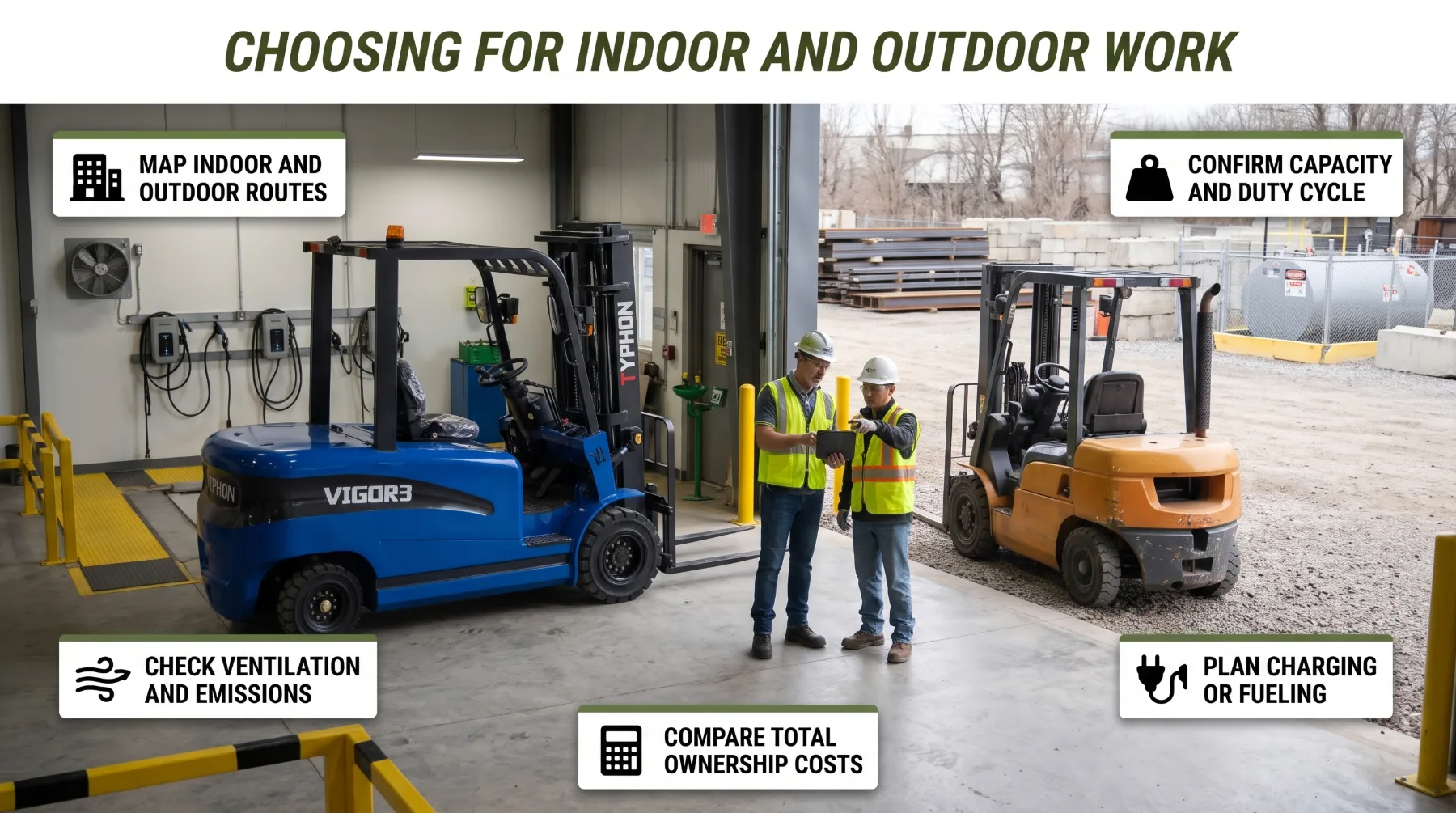
Electric forklifts are built for indoor warehouses and facilities, with some outdoor-rated models available. They produce no exhaust at the point of use, run generally quieter, and typically use cushion tires indoors or pneumatic tires on select outdoor models. Charging time varies by battery type, and routine maintenance covers the battery, electrical, and mechanical systems, with infrastructure needs centered on chargers, electrical capacity, and a dedicated charging area. Diesel forklifts are designed for outdoor yards and demanding industrial settings. They produce exhaust that requires ventilation and emissions controls, run louder especially under load, and use pneumatic or solid pneumatic tires. They refuel quickly, with routine maintenance covering the engine, fuel, emissions, and mechanical systems, supported by fuel supply, safe storage, and spill controls.
For indoor warehouses and facilities, electric models work well on smooth concrete, in narrow aisles, and around sensitive products. Plan charger locations, electrical capacity, and battery strategy before trucks arrive. For outdoor yards and demanding applications, diesel forklifts may fit where their configuration is suitable for gravel, uneven ground, ramps, and heavy loads. Some outdoor-rated electric models can also handle firm outdoor surfaces, so compare both options against your ground conditions and weather exposure.
Operations that move between a warehouse and a yard need careful planning. Options may include separate electric trucks indoors and diesel trucks outdoors with transfer points between them, outdoor-rated electric models that handle both environments within their limits, or another approved power type where ventilation, capacity, and site requirements allow. Base the choice on emissions requirements, capacity needs, ground conditions, and work patterns rather than convenience alone. Before committing, test candidate trucks on your actual floors and yard surfaces with representative loads, checking maneuverability, visibility, ramp performance, and runtime or fuel use across a realistic shift.
Key takeaway: Choose electric forklifts for clean, enclosed, quieter operations with suitable charging, diesel forklifts for rough outdoor ground and heavy, long-hour work, and plan mixed operations around emissions rules, capacity, ground conditions, and real work patterns.
Lifting Capacity and Duty Cycle
One of the most persistent assumptions in forklift buying is that diesel trucks always lift more. In reality, lifting capability depends on the specific model and configuration, not the power source alone.
A forklift's rated capacity is listed on its data plate at a specified load center and lift height. Several factors affect the safe load: the load weight including pallets and packaging, the load center which is the horizontal distance from the fork face to the load's center of gravity, the mast type and lift height since capacity often decreases as the load rises, and any attachments such as sideshifters or clamps which add weight and can move the load forward. Any change to the mast, attachments, or configuration may require an updated data plate, and operators must use the capacity that applies to the truck as it is actually equipped.
Electric forklifts cover a wide capacity range, from compact warehouse trucks to heavy-duty models. Diesel forklifts are common in higher capacity classes and in yard applications where large, heavy loads are routine. Both power types overlap across many common capacity ranges, which is why the decision should rest on the work itself rather than assumptions about power source.
Duty cycle describes how hard and how long the truck works, including hours per shift and shifts per day, number of lifts per hour, typical load weights and lift heights, travel distances, ramps, grades, and time spent idle versus working. An electric truck running multiple heavy shifts may need battery swaps, opportunity charging, or a battery sized for the full workload. A diesel truck can be refueled quickly, but long idle periods waste fuel and add engine hours. List the heaviest routine load, the highest required stacking height, and the attachments you'll use, then confirm the truck's rated capacity under those exact conditions with a sensible margin. Avoid buying based on maximum figures alone.
Key takeaway: Rated capacity depends on load weight, load center, mast, lift height, and attachments rather than power source, so match the forklift to your heaviest routine loads, stacking heights, and real duty cycle instead of assuming one power type always lifts more.
Energy, Fuel, and Operating Costs
Purchase price is only the first cost of forklift ownership. Energy or fuel, maintenance, infrastructure, and downtime often outweigh the initial investment over the life of the truck.
Electric forklifts require charging infrastructure and battery management. Key cost factors include chargers sized and specified for the battery type, electrical service capacity at the charging location, charging area setup including ventilation for lead-acid charging and eyewash stations where required, spare batteries and handling equipment for multi-shift lead-acid operations, and battery replacement at the end of service life which is a significant expense. Electricity is often less expensive per operating hour than diesel fuel, but actual savings depend on local utility rates, demand charges, charging practices, and battery efficiency.
Diesel forklifts require fuel and associated engine servicing. Cost factors include fuel purchases which fluctuate with market prices, fuel storage or delivery including safe storage and spill controls, engine servicing such as oil, filters, coolant, and belts, emissions system upkeep which may include diesel exhaust fluid or particulate filter maintenance on certain engines, and idle time which consumes fuel without moving material.
The most accurate comparison considers the expected service life of the truck and includes purchase or lease price, infrastructure such as chargers or fuel storage, energy or fuel cost per operating hour, routine maintenance and wear items, battery or major component replacement, downtime and lost productivity, and resale or residual value. A truck that costs more upfront can deliver lower total costs over years of steady use. Equally, an operation with light, occasional duty may not recover the cost of new charging infrastructure.
Key takeaway: Electric forklifts require charging infrastructure and battery management while diesel models require fuel and engine servicing, so compare total ownership costs over the expected service life using real operating hours, energy or fuel prices, and maintenance needs.
Indoor Air Quality and Noise
Air quality and noise can be the deciding factors for indoor operations. They affect worker health, product safety, regulatory compliance, and the comfort of everyone sharing the space.
Electric forklifts produce no exhaust emissions at the point of use, making them well suited to enclosed warehouses, cold storage, food and beverage facilities, pharmaceutical operations, and retail environments where site requirements permit. They also avoid the odors associated with combustion engines. Charging still needs attention, since lead-acid batteries can release hydrogen gas during charging, so charging areas must be ventilated and kept free of ignition sources according to applicable requirements.
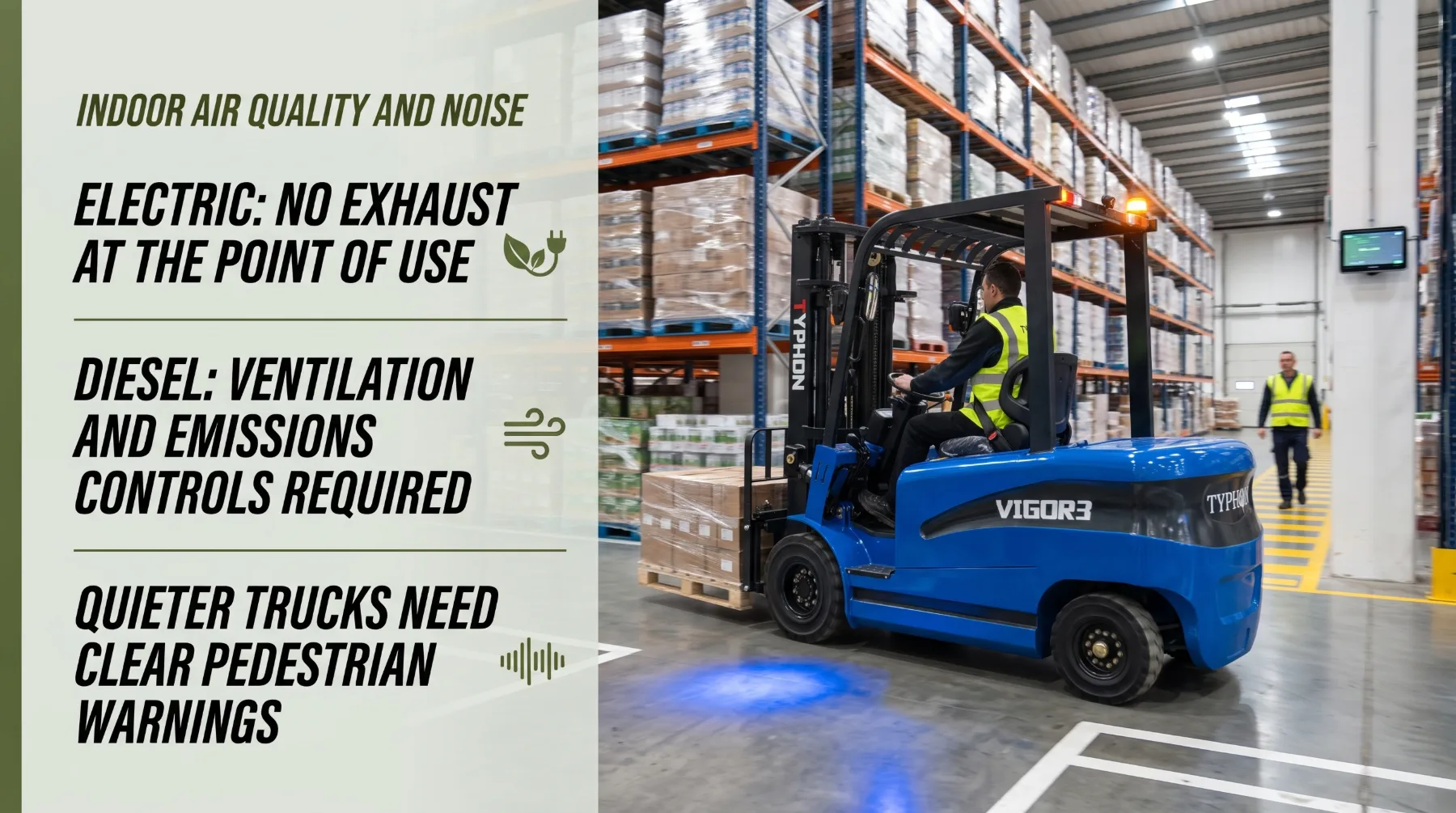
Diesel exhaust contains pollutants such as carbon monoxide, nitrogen oxides, and particulate matter. In enclosed spaces, these can build up and create health hazards for workers. Even modern emissions controls reduce rather than eliminate exhaust, which is why diesel forklifts may be unsuitable for many enclosed spaces. Where any combustion-powered truck enters a building, ventilation, air monitoring, and emissions controls become essential. Follow applicable workplace regulations, site rules, and the manufacturer's guidance before using diesel equipment indoors.
Electric forklifts typically run more quietly than diesel models, which can improve communication between operators and pedestrians and reduce overall noise in the facility. Diesel engines generate more noise, particularly under load. Noise levels still vary by machine, workload, and operating conditions, so check specifications and consider hearing protection requirements in high-noise areas. Quieter trucks also mean pedestrians may not hear them approach, so use horns, warning lights, and blue or red zone lights where fitted, and keep pedestrian walkways clearly marked.
Key takeaway: Electric forklifts produce no exhaust at the point of use and run more quietly, while diesel exhaust makes ventilation and emissions controls critical and may rule out many enclosed spaces, so match the power source to your facility's air quality and noise requirements.
Maintenance and Availability
Forklift uptime depends on how easily each truck can be serviced, refueled, or recharged. Electric and diesel models have different maintenance demands, and both require routine care.
Electric forklifts have fewer engine-related components, which removes tasks such as oil changes and engine tune-ups. They still require consistent attention to batteries including watering and equalizing for flooded lead-acid types and cleaning terminals and cables, electrical systems such as motors, controllers, contactors, and wiring, chargers and charging connectors, and tires, brakes, steering, mast, hydraulic hoses, cylinders, and fluid. Battery condition directly affects runtime and performance, and poor charging habits such as frequent partial charges on lead-acid batteries or deep discharges can shorten battery life.
Diesel forklifts require engine-related servicing in addition to routine forklift inspections. Typical maintenance tasks include engine oil and filter changes, fuel filter replacement, fuel system checks, air filter cleaning or replacement, cooling system inspections, belt checks, and exhaust and emissions system maintenance. Regular inspections of tires, brakes, steering, mast, hydraulics, and freelift mechanisms are also essential for safe operation. For indoor operations, diesel forklifts require particular attention to ventilation and exhaust emissions. Engine exhaust can accumulate in enclosed warehouses and create harmful air quality conditions, so adequate ventilation and appropriate emissions controls are necessary. Diesel forklifts are generally better suited to outdoor yards, loading areas, and well-ventilated industrial spaces. For indoor material handling, electric forklifts are often a more suitable alternative because they produce no exhaust emissions during operation. Dust, mud, and changing weather in outdoor environments can also accelerate wear on filters, seals, and moving components, making consistent maintenance important for reliable performance.
When it comes to availability and uptime, diesel refueling usually takes minutes and supports continuous multi-shift use, while lead-acid charging often takes several hours plus cooling time so multi-shift operations may need spare batteries, and lithium-ion charging can support opportunity charging during breaks to reduce that need. Review local service availability, technician expertise with your chosen power type, and parts supply, since a truck waiting for a technician or a replacement part produces nothing. Regardless of power source, operators should complete a pre-use inspection each shift covering brakes, steering, horn, lights, mast, chains, forks, hydraulics, tires, and fluid or battery condition. In the United States, forklift operators must be trained and evaluated before operating powered industrial trucks.
Key takeaway: Electric forklifts require battery, electrical, and mechanical maintenance while diesel models add engine and emissions servicing, so weigh charging or refueling time, technician expertise, parts supply, and daily inspection needs when planning for uptime.
Conclusion
Electric and diesel forklifts differ in energy requirements, emissions, maintenance needs, and suitable working environments. Electric models produce no exhaust at the point of use and offer quieter operation with less engine-related maintenance, making them suitable for warehouses and enclosed facilities with adequate charging arrangements. Diesel forklifts provide quick refueling and reliable performance on rough outdoor surfaces, but their exhaust requires proper ventilation and limits their suitability for indoor operation. Lifting capacity depends on the specific configuration rather than the power source, while total ownership cost is influenced by operating hours, energy or fuel prices, infrastructure, and maintenance throughout the truck’s service life. Buyers should first identify where each forklift will operate, including enclosed spaces, floor conditions, and outdoor routes. They should then assess routine load weights, stacking heights, attachment requirements, and shift schedules. Reviewing electrical capacity, charging space, and fuel storage options helps determine which power source best fits the facility. Comparing long-term cost estimates and arranging demonstrations on actual warehouse floors and outdoor surfaces can help operators evaluate performance before a purchase decision is made.
Frequently Asked Questions
Which forklift is better for indoor warehouses?
Electric forklifts are often the better choice because they produce no exhaust emissions at the point of use and run more quietly. They suit smooth concrete floors, narrow aisles, and facilities handling food or other sensitive products. Plan charging infrastructure and battery management before deployment.
Are diesel forklifts suitable for enclosed warehouses?
Diesel exhaust creates significant ventilation and emissions concerns in enclosed spaces, and diesel models may be unsuitable for many indoor environments. If any combustion-powered truck must enter a building, use only equipment approved for that environment and follow applicable ventilation, monitoring, and workplace requirements.
Does a diesel forklift always lift more than an electric model?
No. Rated capacity depends on the specific model, load center, mast, lift height, and attachments. Electric and diesel forklifts overlap across many capacity ranges, so compare the data plate ratings for the exact configuration you plan to use.
Which forklift has lower operating costs?
It depends on your operation. Electricity often costs less per hour than diesel fuel, and electric trucks avoid engine servicing, but they require chargers, electrical capacity, and eventual battery replacement. Compare energy or fuel prices, duty cycle, maintenance, infrastructure, and service life to find the lower total cost.