How to Choose a Stone Crusher Based on Output Size and Production Capacity
How to Choose a Stone Crusher Based on Output Size and Production Capacity
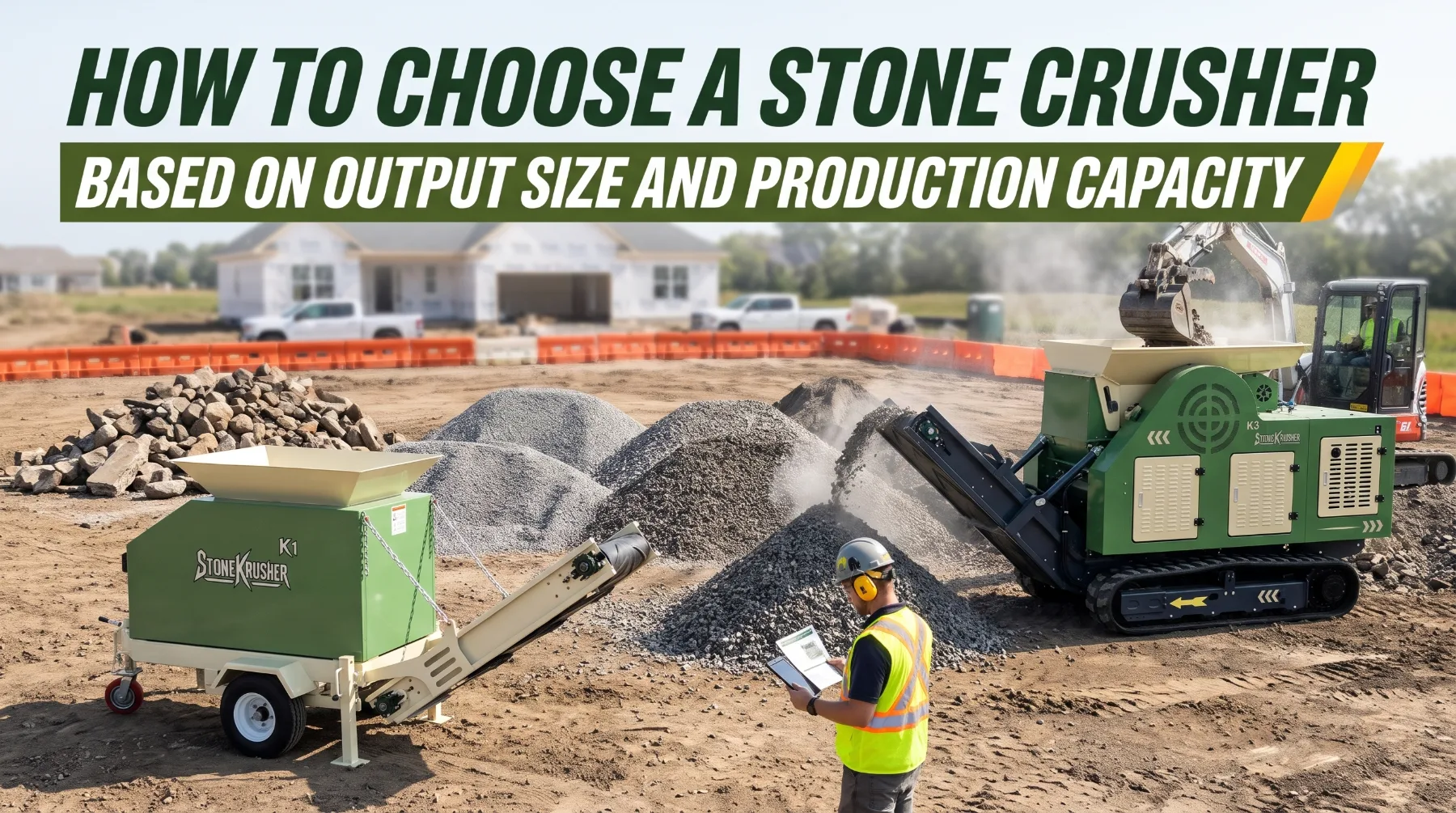
Selecting a stone crusher requires careful consideration of the desired aggregate size and production capacity. Different construction, landscaping, and site development projects require specific material sizes, shapes, and quantities. Not every crusher can produce the same finished material or handle every type of crushing application.
Crusher design, discharge settings, feed material, and machine capacity all influence final output size and production rates. Evaluating these factors together helps equipment buyers identify suitable machines for their intended applications, avoid performance limitations, and manage operating costs. This article explains the key considerations when comparing stone crushers and selecting equipment for different aggregate requirements.
Define the Required Aggregate Size
Every crusher purchase should begin with the finished product, not the machine. Different applications call for different aggregate sizes and gradations, and project specifications often define them precisely. A crusher that can't produce your required product efficiently will leave you with stockpiles you can't use or sell.
Start by listing the products your work requires most often. Road and driveway base is commonly a dense-graded material, such as a 3/4-inch or 1-1/2-inch minus blend that includes fines to help it compact tightly. Drainage stone is usually a clean, open-graded product with fines removed so water can pass through. Pipe bedding often calls for a smaller chip or a specific bedding gradation set by the utility or engineer. Landscaping and decorative work may require a particular size and a cubical particle shape. Backfill and general fill may allow a wider range. These are general examples only, so confirm the exact requirements in your project documents and with local agencies.
Gradation matters as much as top size. A specification may require a defined percentage of material passing each sieve size, along with limits on fines, particle shape, and contaminants. A crusher may produce the correct maximum size and still fail the specification if it creates too many fines or too few. Many specifications for recycled aggregate also require testing and approval before the material is placed, especially for structural base and bedding.
Look beyond your next job. Review the projects you completed over the past year and the work you expect to bid on. If most of your volume is base material with occasional bedding or drainage stone, you need a machine that handles the base efficiently and can adjust or screen for the other products. Defining your full product range first keeps every later comparison grounded in real requirements.
Key takeaway: List the aggregate sizes and gradations your projects actually require, confirm them against specifications, and choose a crusher that can produce your full product range, not just one size.
Consider Crusher Type and Material
Crusher design determines how stone breaks, what shape the finished product takes, and how quickly wear parts need replacement. Jaw, impact, and cone crushers each have clear strengths. Choosing the right type for your stone and product is one of the most important decisions in the entire purchase.
Jaw crushers use compression. A moving jaw squeezes stone against a fixed jaw until it fractures, and the broken pieces drop lower in the chamber until they pass through the gap at the bottom. Jaw crushers handle hard, abrasive stone such as granite and basalt well, along with recycled concrete. They accept large feed, which makes them common primary crushers on compact and mobile units. Their wear costs in hard stone are generally lower than impactors. The trade-off is particle shape, since jaw-crushed output tends to be somewhat blocky or elongated.
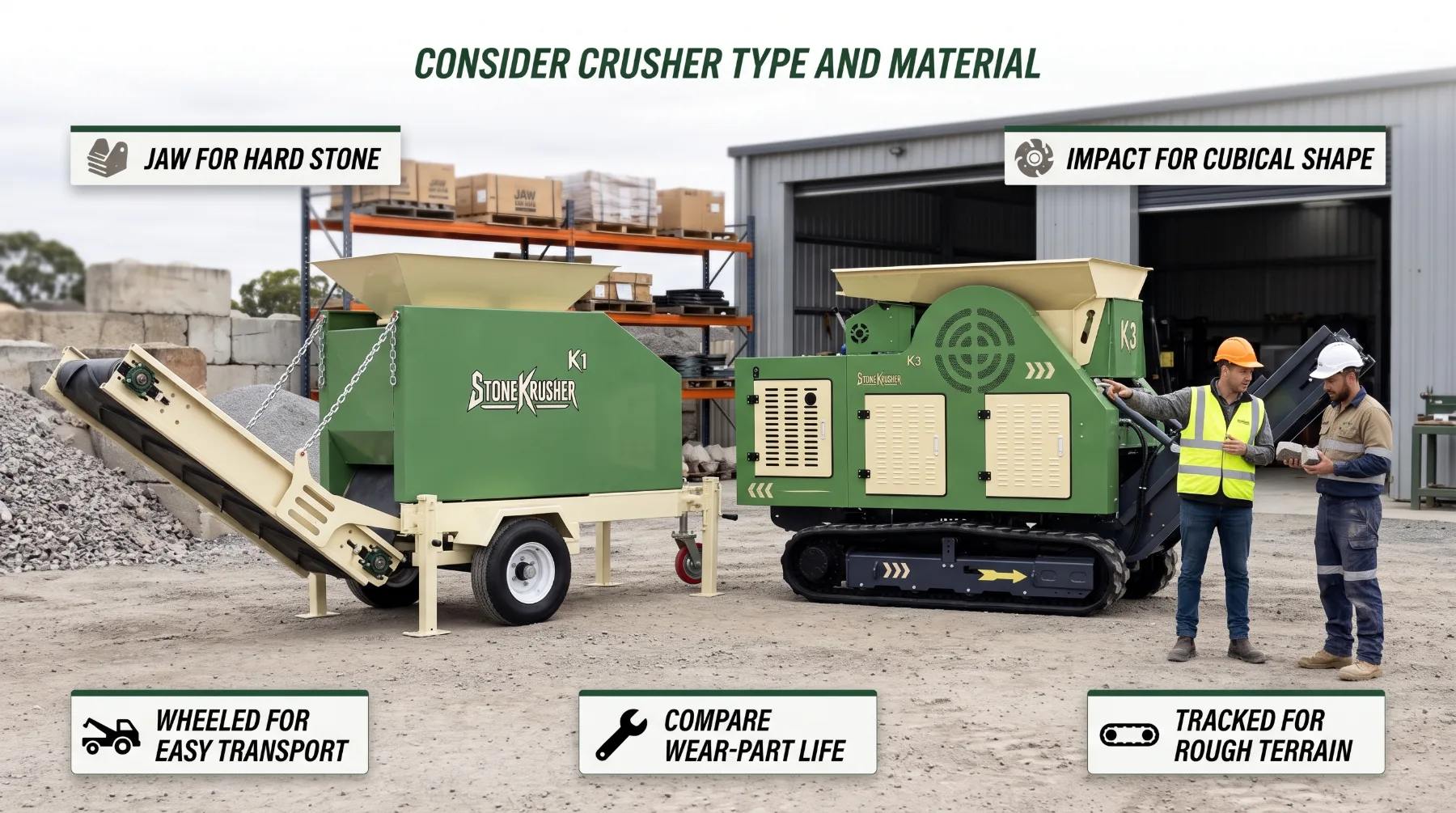
Impact crushers use speed. A rotor fitted with blow bars spins at high speed, striking stone and throwing it against impact aprons, where it shatters. Impact crushers produce a more cubical particle shape, which many base and asphalt aggregate specifications favor. They also handle recycled concrete and asphalt effectively and can produce a good product in a single pass. However, blow bars and aprons wear quickly in hard, abrasive stone, so impactors are typically best suited to softer and medium-hard materials such as limestone and demolition debris.
Cone crushers compress stone between a gyrating mantle and a stationary concave liner. They are usually secondary or tertiary crushers, used to refine material that has already passed through a primary crusher. Cone crushers produce well-shaped, finer aggregate and handle hard stone with reasonable wear costs, but they need properly sized feed and are less common as standalone compact units.
Evaluate your materials honestly. Note the stone's hardness and abrasiveness, the presence of rebar or contaminants in recycled concrete, and the moisture and clay content of your feed. Then match those factors with your required product shape and volume. Ask each manufacturer which materials its crusher is rated to process, how it handles reinforced concrete, and whether a magnetic separator is available. Request wear-part life estimates based on material similar to yours.
Key takeaway: Choose a jaw crusher for hard, abrasive stone and large feed, an impact crusher for softer material and cubical shape, and a cone crusher for refining pre-crushed stone into finer, well-shaped aggregate.
Compare Hourly Production Capacity
Production capacity, usually listed in tons per hour, tells you how quickly a crusher can process material. It is one of the most important purchasing figures, and one of the easiest to misread. A headline capacity often reflects ideal test conditions that rarely match a real jobsite.
Manufacturers typically measure capacity using medium-hard stone of a known density, clean and dry feed well within the feed opening, a specific closed side setting, and a steady, uninterrupted feed. Some publish a single maximum figure, while others provide a capacity table across several settings. The maximum is usually measured at the widest setting, which produces the coarsest product. If you need finer aggregate, expect lower tonnage. Also check whether figures are stated in short tons or metric tonnes, since the two differ by about 10%.
Compare machines on equal terms. Ask each manufacturer for its capacity at the setting that produces your most common product, using material similar to yours. Material hardness, moisture, clay content, and the amount of fines in the feed all affect real throughput. Wet, sticky material in particular can pack the chamber and slow production noticeably. A crusher that looks productive on paper may deliver far less when crushing hard granite to a 3/4-inch product than it does with dry limestone at a wide setting.
Then turn capacity into a working estimate. Real jobsite output depends on feeding consistency, discharge clearance, blockages, setting changes, refueling, and maintenance. Build a realistic utilization rate into your planning rather than multiplying the rated figure by working hours. Calculate how many tons your typical projects require and how many days that volume would take at a realistic rate. A machine that fits your schedule at a sensible utilization rate is the right size. One that only meets your schedule at its rated maximum leaves no margin.
Key takeaway: Compare tons per hour at your required output setting and with material similar to yours, confirm the units, and plan around realistic utilization rather than the headline rating.
Match the Feed Opening to Available Stone
The feed opening decides which pieces of stone can enter the crushing chamber. It shapes how much preparation your crew must do before crushing and how steadily the machine can run. A crusher with a feed opening that suits your typical material reduces breaking work and keeps production moving.
Check the maximum feed size and opening dimensions for each model. On jaw crushers, a common rule of thumb is that the largest piece fed should be no more than about 80% of the opening's smaller dimension. Material larger than that can bridge across the top of the jaws, sit without breaking, and stop production. Always confirm the manufacturer's stated maximum feed size for the exact model, since chamber design and jaw profile affect what the machine accepts.
Compare that figure with the stone on your site. Excavated boulders, concrete slabs, and old footings are often larger than they appear once they are broken loose. If much of your feed exceeds the crusher's limit, every oversized piece needs to be reduced with a hydraulic breaker or pulverizer first. That preparation adds labor, equipment time, and cost to every ton. In some cases, a crusher with a larger feed opening saves more in preparation than it costs in purchase price.
Feed size also affects which crusher type makes sense. Primary crushers, typically jaw crushers, accept larger feed and reduce it to a manageable size. Secondary crushers, such as cone crushers, need material that has already been reduced. If your stone arrives large and your product is fine, you may need a primary crusher alone with screening, or a two-stage setup. Match the feeding equipment as well. The excavator or loader supplying the hopper should place material steadily without overfilling it or dropping large pieces from height.
Key takeaway: Compare the crusher's maximum feed size with the largest stone on your sites, and weigh the cost of pre-breaking oversized material against a machine with a larger opening.
Include Mobility and Operating Costs
A crusher that meets your output and capacity targets still has to reach your sites and run within your budget. Mobility, setup, fuel, wear parts, and service support all shape the true cost of ownership. Contractors who account for them before buying make better decisions and price their crushing work more accurately.
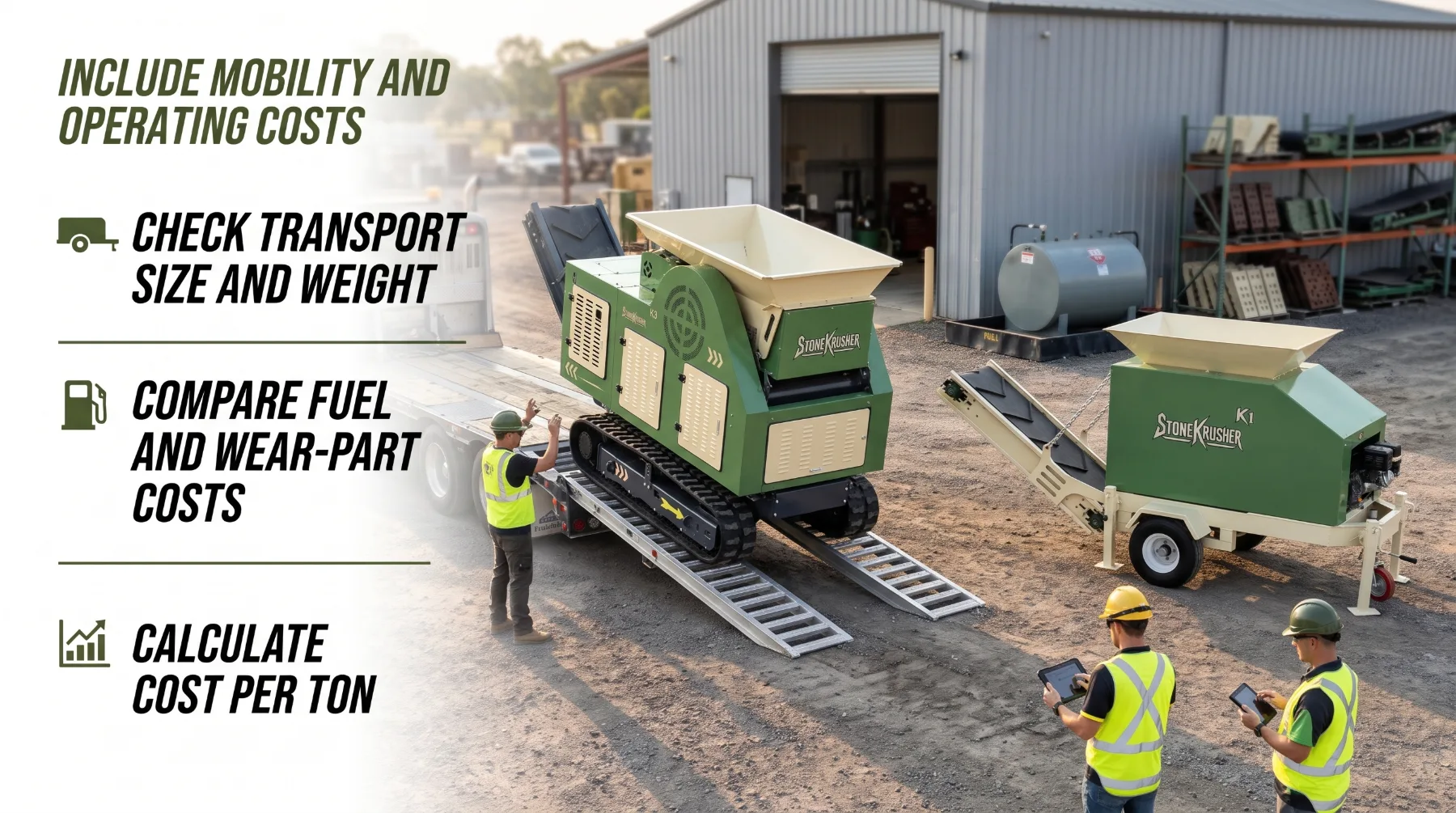
Start with mobility. Compact crushers come in tracked, towable, and skid-mounted designs, and some small units mount on excavators or skid steers as attachments. Tracked crushers drive onto a trailer and walk into position on rough ground. Towable crushers suit contractors who move often on public roads. Attachment crushers use the carrier's hydraulics and fit very small volumes and confined sites, though their output is limited. Compare transport dimensions, machine weight, and trailer or towing requirements with your current fleet and the regulations that apply to your hauling setup. Also check setup time, footprint, and the space needed for feeding, crushing, and stockpiling on your typical sites.
Next, look at power and fuel. Most compact crushers use a diesel engine that drives the chamber and conveyors directly or through hydraulics, while some offer electric drive where site power is available. Compare rated engine power, fuel consumption under typical load, and emissions compliance for your location. For attachment crushers, confirm that your carrier's hydraulic flow and pressure meet the crusher's requirements.
Wear parts are usually the largest recurring expense. Jaw plates, cheek plates, blow bars, aprons, liners, conveyor belts, bearings, and screens all wear with use, and abrasive stone speeds that wear. Ask how long key parts last in material similar to yours, whether jaw plates can be flipped to extend life, how long replacements take, and what parts cost. Review service intervals, maintenance access, and lubrication requirements. Confirm parts availability, delivery times, warranty terms, and technical support in writing, since a crusher waiting on a jaw plate produces nothing.
Combine these figures into a cost per ton. Include fuel, wear parts, routine service, operator time, transport, and expected downtime. Compare that figure with the cost of hauling material away and buying aggregate. A crusher that looks affordable at purchase but carries high wear costs in your stone may cost more over time than a pricier machine suited to your material. Once the machine is working, track actual tons, fuel use, and part replacements to refine your costs and bids.
Key takeaway: Compare transport, setup, fuel use, wear-part life, service access, and parts support alongside purchase price, and calculate cost per ton based on your own material.
Conclusion
The right stone crusher produces the aggregate your projects need at a dependable production rate. Start by identifying the required sizes and gradations, then compare each machine’s adjustment range and screening options. Check rated capacity at your target output setting using material similar to what you process. The feed opening must accommodate the largest stone on your sites, while the crusher type, whether jaw, impact, or cone, should suit the material’s hardness and the required product shape. Mobility, fuel consumption, wear-part costs, and service support also affect long-term value. Evaluate your typical products, production volumes, and largest feed sizes, then request written specifications covering capacity, adjustment ranges, feed limits, transport dimensions, fuel use, and wear-part costs. A demonstration using your own material at your most common setting will help confirm performance and ensure the crusher can produce specification-ready aggregate consistently.
Frequently Asked Questions
Why is output size important when buying a crusher?
Output size determines whether the finished aggregate meets your project specifications for base, bedding, drainage, or landscaping. A crusher that can't reach your required size or gradation efficiently will produce material you can't use or will need extra screening and recrushing.
What does tons per hour mean?
Tons per hour is the crusher's stated material-processing rate under specified test conditions, including material type, feed size, and output setting. Compare machines at your required setting and confirm whether figures are in short tons or metric tonnes.
Can one crusher handle every rock type?
No. Material hardness, abrasiveness, and crusher design determine suitability. Jaw crushers generally handle hard, abrasive stone well, while impact crushers suit softer and medium-hard materials. Confirm which materials each model is rated to process.
Should transport requirements affect crusher selection?
Yes. Machine dimensions, weight, mobility type, setup time, and site footprint all affect how easily the crusher moves between jobs and fits your sites. A crusher that is difficult to transport or position may spend more time idle than producing.